
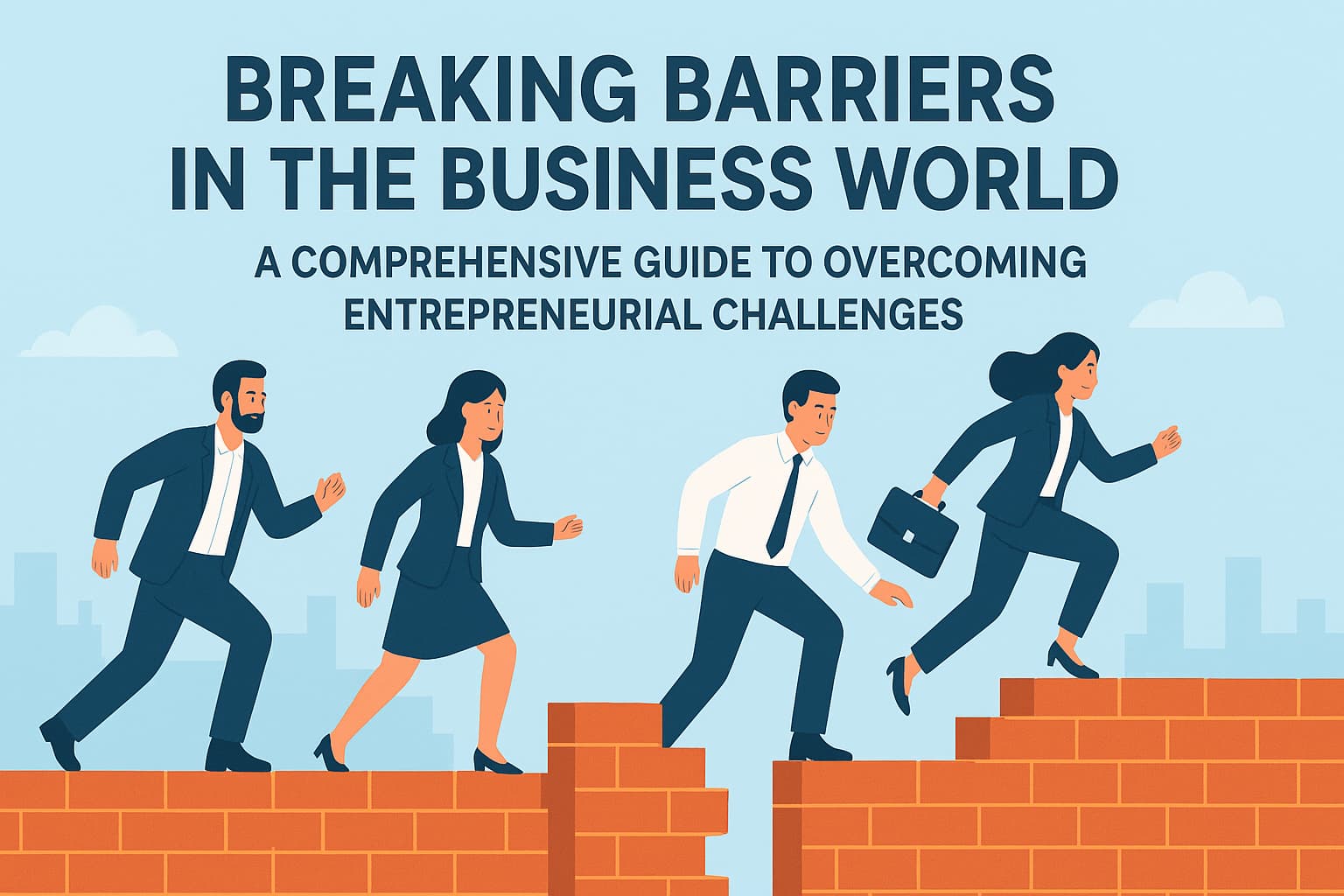
In today’s rapidly evolving marketplace, entrepreneurs and business leaders face unprecedented challenges that can make or break their ventures. The modern business landscape is littered with obstacles that seem insurmountable, yet countless success stories prove that with the right mindset, strategies, and determination, these barriers can be transformed into stepping stones toward extraordinary achievement.
The concept of breaking barriers in business extends far beyond simply overcoming financial constraints or market competition. It encompasses a holistic approach to identifying, understanding, and systematically dismantling the various obstacles that prevent organizations from reaching their full potential. Whether you’re a startup founder, seasoned executive, or aspiring entrepreneur, understanding how to navigate these challenges is crucial for long-term success and sustainable growth.
Understanding the Nature of Business Barriers
Business barriers are multifaceted challenges that can emerge from internal organizational dynamics, external market forces, regulatory environments, or even psychological limitations within leadership teams. These obstacles often interconnect, creating complex webs of challenges that require sophisticated solutions and strategic thinking.
The first step in breaking barriers is recognition. Many businesses fail not because they lack talent or resources, but because they fail to identify the specific barriers holding them back. This lack of awareness creates a cycle where organizations repeatedly encounter the same problems without understanding their root causes.
Successful barrier-breaking begins with comprehensive analysis. Companies must conduct thorough assessments of their operations, market position, competitive landscape, and internal capabilities. This diagnostic phase reveals not only obvious obstacles but also subtle impediments that might be constraining growth or innovation.
The Psychology Behind Barrier Formation
Understanding why barriers exist in the first place is essential for developing effective strategies to overcome them. Many business barriers stem from psychological factors, including fear of failure, resistance to change, and cognitive biases that influence decision-making processes.
Fear-based barriers often manifest as reluctance to invest in new technologies, hesitation to enter new markets, or resistance to organizational restructuring. These psychological obstacles can be particularly challenging because they’re often subconscious and deeply ingrained in company culture.
Cognitive biases also play a significant role in barrier formation. Confirmation bias might prevent leaders from seeing market opportunities that contradict their existing beliefs, while status quo bias can maintain inefficient processes simply because they’re familiar and comfortable.
Strategic Frameworks for Barrier Identification
Effective barrier-breaking requires systematic approaches to identification and analysis. Several proven frameworks can help organizations uncover hidden obstacles and develop targeted solutions.
The SWOT analysis (Strengths, Weaknesses, Opportunities, Threats) remains one of the most valuable tools for comprehensive barrier assessment. This framework helps organizations identify internal barriers (weaknesses) and external barriers (threats) while simultaneously revealing potential solutions through strengths and opportunities.
Another powerful approach is the Five Forces Analysis, developed by Michael Porter. This framework examines competitive rivalry, supplier power, buyer power, threat of substitution, and barriers to entry. Understanding these forces helps businesses identify specific market barriers and develop strategies to overcome or circumvent them.
Technology as a Barrier-Breaking Tool
In the digital age, technology serves as one of the most powerful tools for breaking traditional business barriers. Artificial intelligence, machine learning, automation, and cloud computing are revolutionizing how businesses operate and compete.
Technology can eliminate geographical barriers through remote work capabilities and global communication tools. Small businesses can now access international markets with the same ease that was once reserved for multinational corporations. E-commerce platforms, digital marketing tools, and online payment systems have democratized global business participation.
Artificial intelligence and machine learning are breaking barriers in data analysis, customer service, and operational efficiency. These technologies can process vast amounts of information, identify patterns, and make predictions that would be impossible for human analysts to achieve manually.
Financial Barriers and Creative Solutions
Financial constraints represent some of the most common barriers in business, but innovative approaches are expanding access to capital and reducing financial obstacles. Traditional funding methods are being supplemented by crowdfunding, peer-to-peer lending, venture capital networks, and alternative financing options.
The emergence of fintech companies has democratized access to financial services, making it easier for small businesses and entrepreneurs to obtain loans, process payments, and manage cash flow. Mobile banking, digital wallets, and blockchain technology are eliminating traditional barriers between businesses and financial institutions.
Creative financial strategies can transform perceived barriers into competitive advantages. Revenue sharing agreements, strategic partnerships, and equity arrangements can provide access to resources and markets that might otherwise be financially prohibitive.
Building Barrier-Breaking Organizational Culture
Creating a culture that naturally identifies and overcomes barriers requires intentional leadership and systematic approach to organizational development. Companies must cultivate environments where innovation is encouraged, failure is viewed as learning opportunity, and continuous improvement is embedded in daily operations.
Leadership plays a crucial role in barrier-breaking culture. Leaders must model resilience, adaptability, and creative problem-solving. They need to communicate clearly about obstacles while maintaining optimism about solutions and outcomes.
Employee empowerment is another critical component. When team members feel authorized to identify problems and propose solutions, organizations can leverage collective intelligence to address barriers more effectively. This distributed approach to problem-solving often reveals insights that traditional top-down management might miss.
Ten Surmountable Barriers in the Business World
Throughout the entrepreneurial journey, several common barriers repeatedly challenge business success. Understanding these obstacles and proven strategies for overcoming them can significantly improve your chances of sustainable growth and profitability.
1. Limited Access to Capital: Financial constraints often represent the most immediate barrier for new businesses and growing companies. However, modern financing options including crowdfunding platforms, angel investors, venture capital, government grants, and peer-to-peer lending provide multiple pathways to securing necessary funding.
2. Lack of Market Awareness: Many excellent products and services fail because potential customers don’t know they exist. Digital marketing strategies, social media engagement, content marketing, and strategic partnerships can build brand recognition and customer awareness without requiring massive advertising budgets.
3. Regulatory Compliance Challenges: Complex regulations can seem overwhelming, but they’re navigable with proper guidance. Consulting with legal experts, joining industry associations, and utilizing compliance software can transform regulatory requirements from barriers into competitive advantages through proper adherence.
4. Technology Adoption Resistance: Fear of new technology can keep businesses competitive disadvantage. Gradual implementation, employee training programs, and partnering with technology consultants can ease transitions and unlock operational efficiencies that justify initial investments.
5. Talent Acquisition and Retention: Finding and keeping qualified employees challenges many organizations. Competitive compensation packages, professional development opportunities, flexible work arrangements, and positive company culture can attract top talent even when resources are limited.
6. Scaling Operations Effectively: Growing too quickly or too slowly both present significant challenges. Systematic planning, process documentation, performance metrics, and scalable systems can ensure that growth strengthens rather than destabilizes business operations.
7. Competition from Established Players: Competing against larger, more established companies requires strategic differentiation. Focusing on niche markets, providing superior customer service, innovating rapidly, and building strong customer relationships can create sustainable competitive advantages.
8. Supply Chain Disruptions: Global events can severely impact supply chains, but diversification strategies can provide resilience. Multiple supplier relationships, local sourcing options, inventory management systems, and flexible production capabilities can minimize disruption impacts.
9. Customer Acquisition Costs: High costs for acquiring new customers can make growth unsustainable. Content marketing, referral programs, customer loyalty initiatives, and social media engagement can reduce acquisition costs while building stronger customer relationships.
10. Economic Uncertainty and Market Volatility: External economic factors create unpredictable business environments. Diversified revenue streams, flexible business models, strong cash reserves, and scenario planning can help businesses navigate economic turbulence successfully.
Innovation as a Barrier-Breaking Strategy
Innovation serves as one of the most effective approaches to breaking business barriers because it fundamentally changes the rules of engagement within industries. Companies that embrace innovative thinking often discover that perceived barriers become opportunities for differentiation and competitive advantage.
Disruptive innovation particularly excels at breaking traditional barriers. By approaching problems from entirely different angles, businesses can often circumvent established obstacles rather than confronting them directly. This approach has enabled numerous startups to compete successfully against much larger, more established companies.
Innovation doesn’t always require revolutionary breakthroughs. Incremental improvements, process optimizations, and creative applications of existing technologies can often overcome significant barriers with relatively modest investments.
The Role of Strategic Partnerships
Strategic partnerships represent powerful mechanisms for breaking barriers that might be insurmountable for individual organizations. Through collaboration, businesses can access new markets, share resources, combine expertise, and reduce risks associated with barrier-breaking initiatives.
Partnership strategies can take many forms, from formal joint ventures to informal collaboration agreements. The key is identifying partners whose strengths complement your weaknesses and whose goals align with your barrier-breaking objectives.
Successful partnerships require clear communication, defined expectations, mutual benefits, and structured agreements that protect all parties’ interests while enabling collaborative success.
Measuring Progress in Barrier-Breaking
Effective barrier-breaking requires systematic measurement and evaluation of progress. Without clear metrics, it’s impossible to determine whether strategies are working or need adjustment.
Key performance indicators should be established for each barrier-breaking initiative. These metrics might include revenue growth, market share expansion, operational efficiency improvements, customer satisfaction scores, or employee engagement levels.
Regular review processes ensure that barrier-breaking efforts remain aligned with overall business objectives and can be adjusted as circumstances change or new barriers emerge.
Future-Proofing Against Emerging Barriers
The business landscape continues evolving rapidly, creating new barriers while eliminating others. Successful organizations must develop capabilities for identifying and addressing emerging barriers before they become significant obstacles.
Trend analysis, scenario planning, and continuous learning help businesses anticipate future barriers and develop proactive strategies. This forward-thinking approach transforms barrier-breaking from reactive problem-solving into proactive competitive advantage.
Conclusion
Breaking barriers in the business world requires combination of strategic thinking, innovative approaches, and persistent execution. While obstacles are inevitable in any business venture, they need not be permanent impediments to success.
The most successful businesses are those that view barriers as opportunities for differentiation, innovation, and growth. By developing systematic approaches to barrier identification, creative strategies for overcoming obstacles, and cultures that embrace challenge as catalyst for improvement, organizations can transform perceived limitations into competitive advantages.
Remember that barrier-breaking is ongoing process rather than one-time achievement. As businesses grow and markets evolve, new barriers will emerge while old ones may disappear. The key to sustained success lies in maintaining vigilance, adaptability, and commitment to continuous improvement.
The future belongs to organizations that can effectively identify, analyze, and overcome the barriers that constrain their potential. With proper strategies, mindset, and execution, virtually any business barrier can be transformed from an insurmountable obstacle into a stepping stone toward extraordinary success.