
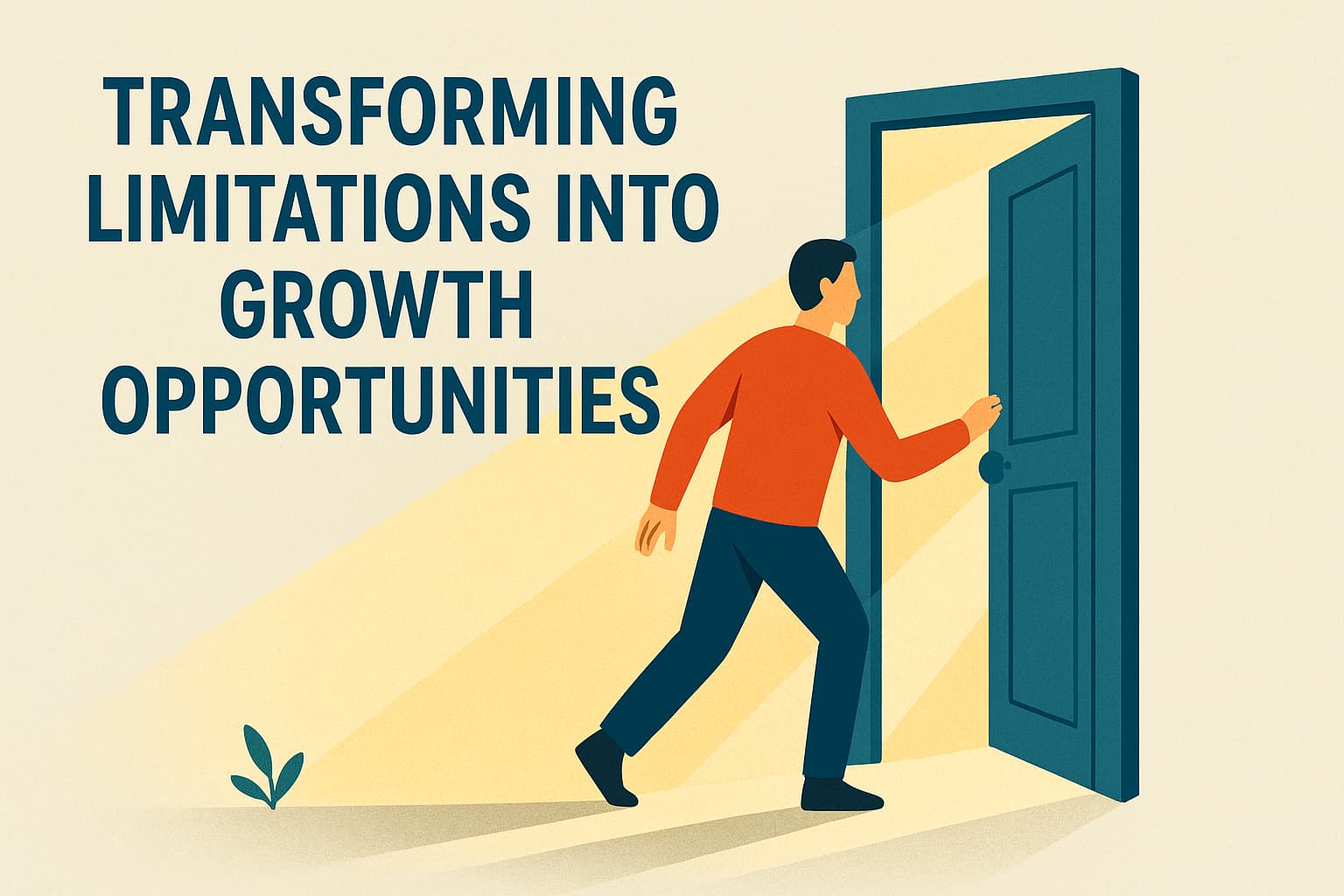
Discover how to transform personal and professional limitations into powerful catalysts for growth. Learn proven strategies to overcome obstacles, build resilience, and achieve extraordinary success through adversity.
Life presents us with countless limitations—some self-imposed, others thrust upon us by circumstances beyond our control. Yet within these apparent constraints lies an extraordinary paradox: our greatest limitations often become the very catalysts that propel us toward unprecedented growth and success. The art of transforming limitations into growth opportunities represents one of humanity’s most powerful capabilities, distinguishing those who merely survive from those who truly thrive.
Understanding the Nature of Limitations
Limitations manifest in various forms throughout our personal and professional lives. Financial constraints may prevent us from pursuing certain educational opportunities or business ventures. Physical limitations might challenge our mobility or capabilities. Social circumstances can restrict our access to networks and resources. Mental barriers, often the most challenging of all, can create invisible cages that confine our potential within self-imposed boundaries.
However, the most successful individuals throughout history have demonstrated a remarkable ability to reframe these limitations not as permanent obstacles, but as temporary challenges that demand creative solutions. This fundamental shift in perspective transforms the entire landscape of possibility, converting what initially appears as disadvantage into competitive advantage.
Consider the story of countless entrepreneurs who launched successful businesses precisely because they lacked traditional resources. Without substantial capital, they were forced to become resourceful, developing lean business models that their well-funded competitors couldn’t match. Without established networks, they built authentic relationships from the ground up. Without formal business education, they learned through direct experience, developing practical wisdom that textbooks couldn’t provide.
The Psychology Behind Limitation-Driven Growth
The human brain possesses an extraordinary capacity for adaptation and innovation when faced with constraints. This phenomenon, known as constraint-induced creativity, occurs when limitations force us to think beyond conventional approaches and explore previously unconsidered alternatives. Research in cognitive psychology demonstrates that individuals often produce their most innovative solutions when working within specific parameters rather than having unlimited freedom.
This psychological principle manifests in numerous real-world scenarios. Artists working with limited materials often create their most memorable pieces. Writers constrained by word limits frequently produce their most impactful prose. Athletes recovering from injuries often discover new techniques that ultimately enhance their performance beyond previous levels.
The key lies in understanding that our brains are naturally wired to find solutions when confronted with challenges. Limitations activate our problem-solving mechanisms, encouraging lateral thinking and fostering the development of skills we might never have cultivated under different circumstances.
Developing a Growth-Oriented Mindset
Transforming limitations into opportunities begins with cultivating a growth-oriented mindset—a fundamental belief that abilities and intelligence can be developed through dedication, hard work, and learning from failure. This mindset stands in stark contrast to a fixed mindset, which views limitations as permanent characteristics that cannot be changed or overcome.
Individuals with growth-oriented mindsets approach limitations with curiosity rather than defeat. They ask empowering questions: “What can this situation teach me?” “How might this limitation force me to develop new skills?” “What innovative approaches might emerge from working within these constraints?” These questions shift focus from the limitation itself to the potential growth opportunities it presents.
Developing this mindset requires consistent practice and conscious effort. It involves reframing internal dialogue, celebrating small victories, and viewing setbacks as valuable learning experiences rather than evidence of inadequacy. This transformation doesn’t happen overnight, but with persistent application, it becomes a natural way of approaching challenges.
Strategic Approaches to Limitation Transformation
Successfully transforming limitations into growth opportunities requires strategic thinking and purposeful action. The first step involves conducting an honest assessment of current limitations, categorizing them into areas such as skills, resources, knowledge, networks, or circumstances. This inventory provides a clear foundation for developing targeted transformation strategies.
Once limitations are identified and categorized, the next phase involves exploring creative alternatives and workarounds. This process often requires thinking beyond traditional solutions and considering unconventional approaches. For instance, limited financial resources might lead to exploring partnership opportunities, developing skills through online platforms, or creating value-based exchange relationships.
Resource optimization becomes crucial during this phase. Successful individuals learn to maximize the utility of available resources while simultaneously developing strategies to acquire new ones. This might involve leveraging technology to amplify capabilities, building strategic relationships to access networks, or developing complementary skills that create unique value propositions.
The transformation process also benefits from systematic experimentation. Rather than waiting for perfect conditions or unlimited resources, successful individuals begin taking action with available means, learning and adjusting as they progress. This approach, sometimes called “effectuation,” allows for rapid learning and adaptation while building momentum toward larger goals.
Building Resilience Through Adversity
Limitations often serve as powerful training grounds for developing resilience—the capacity to recover quickly from difficulties and adapt to challenging circumstances. Resilience isn’t an innate trait but rather a skill that strengthens through practice and experience. Each successfully navigated limitation builds confidence and capability for handling future challenges.
The development of resilience through limitation involves several key components. Emotional regulation enables individuals to maintain composure and clear thinking during difficult periods. Problem-solving skills evolve through repeated exposure to challenges requiring creative solutions. Adaptability grows as individuals learn to adjust strategies based on changing circumstances and new information.
Perhaps most importantly, experiencing and overcoming limitations builds what psychologists call “self-efficacy”—the belief in one’s ability to execute behaviors necessary to produce specific performance attainments. This confidence becomes a self-reinforcing cycle, where success in overcoming one limitation increases confidence in addressing future challenges.
Real-World Applications and Success Stories
The business world provides countless examples of limitation-driven innovation and growth. Technology companies have emerged from garage startups with minimal funding, using resource constraints as catalysts for developing lean, efficient operations that established competitors couldn’t match. Service businesses have built competitive advantages by focusing on areas where larger companies couldn’t compete effectively due to their size and complexity.
In personal development contexts, individuals have transformed career limitations into opportunities for entrepreneurship, education constraints into self-directed learning journeys, and social limitations into platforms for building authentic communities around shared interests and values.
The key insight from these success stories lies not in the specific strategies employed, but in the fundamental approach: viewing limitations as temporary conditions that demand creative responses rather than permanent barriers that define possible outcomes.
Practical Implementation Strategies
Implementing limitation transformation requires structured approaches that can be adapted to individual circumstances and goals. The first practical step involves developing what might be called “limitation literacy”—the ability to accurately identify, assess, and categorize different types of limitations without becoming overwhelmed or discouraged by their presence.
This assessment process should include both internal limitations (skills, knowledge, confidence, habits) and external limitations (resources, circumstances, market conditions, regulations). Understanding the difference between these categories helps determine which limitations can be directly addressed through personal development and which require strategic workarounds or alternative approaches.
Once limitations are clearly identified, the next step involves prioritizing which ones to address first. This prioritization should consider factors such as impact potential, resource requirements, timeline constraints, and interdependencies between different limitations. Focusing on high-impact, achievable transformations builds momentum and confidence for addressing more complex challenges.
Creating Systems for Continuous Growth
Sustainable limitation transformation requires establishing systems that support continuous learning and adaptation. These systems should include regular assessment mechanisms for identifying new limitations and opportunities, structured approaches for developing new capabilities, and feedback loops for measuring progress and adjusting strategies.
Documentation plays a crucial role in this process. Maintaining records of challenges faced, strategies attempted, results achieved, and lessons learned creates a valuable resource for future decision-making and helps identify patterns that might not be apparent in the moment.
The development of personal advisory networks also proves invaluable for limitation transformation. These networks might include mentors, peers facing similar challenges, industry experts, or individuals who have successfully navigated comparable situations. Such relationships provide external perspectives, accountability, and access to resources that might otherwise remain unavailable.
The Compound Effect of Transformed Limitations
One of the most powerful aspects of limitation transformation lies in its compound effect over time. Each successfully transformed limitation not only removes a specific barrier but also builds capabilities that can be applied to future challenges. Skills developed while working within one constraint often prove valuable in completely different contexts.
This compound effect explains why individuals who have overcome significant early limitations often demonstrate exceptional resilience and adaptability throughout their careers. They have developed what might be called “transformation muscles”—mental and emotional capabilities that automatically engage when new limitations are encountered.
The compound effect also extends to external recognition and opportunities. Individuals known for their ability to thrive despite limitations often attract opportunities specifically because of this demonstrated capability. Organizations and collaborators seek out people who have proven their ability to deliver results regardless of constraints.
Future-Proofing Through Limitation Mastery
In an rapidly changing world, the ability to transform limitations into opportunities becomes increasingly valuable. Economic shifts, technological disruptions, and social changes constantly introduce new constraints and challenges. Individuals who have mastered the art of limitation transformation are better positioned to adapt and thrive regardless of external circumstances.
This adaptability extends beyond immediate practical benefits to include deeper personal satisfaction and fulfillment. When limitations are viewed as growth opportunities rather than barriers, challenges become exciting rather than overwhelming. This fundamental shift in perspective can transform not only outcomes but also the quality of the journey toward those outcomes.
Conclusion
Transforming limitations into growth opportunities represents both an art and a science—requiring creativity and strategic thinking, emotional intelligence and practical skills, patience and persistence. The individuals who master this capability don’t simply overcome obstacles; they use those obstacles as stepping stones to achievements that might never have been possible under different circumstances.
The journey from limitation to opportunity rarely follows a straight path. It involves setbacks and breakthroughs, moments of doubt and periods of clarity, incremental progress and sudden insights. Yet for those committed to the process, limitations cease to be sources of frustration and become sources of competitive advantage and personal growth.
In embracing this approach to limitations, we discover that our greatest constraints often point toward our greatest opportunities. The very things that seem to limit us may actually be directing us toward paths we would never have discovered otherwise—paths that lead not only to achievement but to the development of capabilities and insights that enrich every aspect of our lives.
The transformation of limitations into growth opportunities stands as one of humanity’s most powerful capabilities. In developing and applying this skill, we join the ranks of those who don’t merely survive their circumstances but use those circumstances as fuel for extraordinary achievement and personal fulfillment.