
Meta Description: Discover how cutting-edge assistive technology transforms daily life for people with disabilities, breaking barriers and creating unprecedented opportunities for independence, communication, and success in 2025.
The Silent Revolution Transforming Millions of Lives
In a world where technology evolves at breakneck speed, one of its most profound impacts often goes unnoticed by mainstream media—the revolutionary transformation of lives through assistive technology. For over 1.3 billion people worldwide living with disabilities, technological innovations aren’t just convenience upgrades; they’re life-changing tools that shatter barriers, restore independence, and unlock human potential in ways previously thought impossible.
The landscape of assistive technology has evolved dramatically from basic mechanical aids to sophisticated AI-powered systems that anticipate needs, adapt to preferences, and seamlessly integrate into daily routines. This technological renaissance isn’t just improving quality of life—it’s fundamentally redefining what’s possible for individuals with disabilities across every sphere of human experience.
Breaking Down the Barriers: Understanding Modern Assistive Technology
Assistive technology encompasses any device, software, or system designed to maintain, increase, or improve functional capabilities of individuals with disabilities. However, today’s definition extends far beyond traditional wheelchairs and hearing aids. Modern assistive technology represents a convergence of artificial intelligence, machine learning, biotechnology, and human-centered design principles.
The current generation of assistive devices operates on predictive algorithms that learn user patterns, environmental sensors that provide real-time feedback, and cloud-based systems that enable remote support and continuous updates. This interconnected ecosystem creates a personalized support network that adapts and evolves with the user’s changing needs and circumstances.
What makes contemporary assistive technology truly revolutionary is its invisible integration into everyday life. Unlike previous generations of assistive devices that often marked users as different, today’s solutions blend seamlessly into mainstream technology, promoting inclusion rather than highlighting differences.
Communication Revolution: Giving Voice to the Voiceless
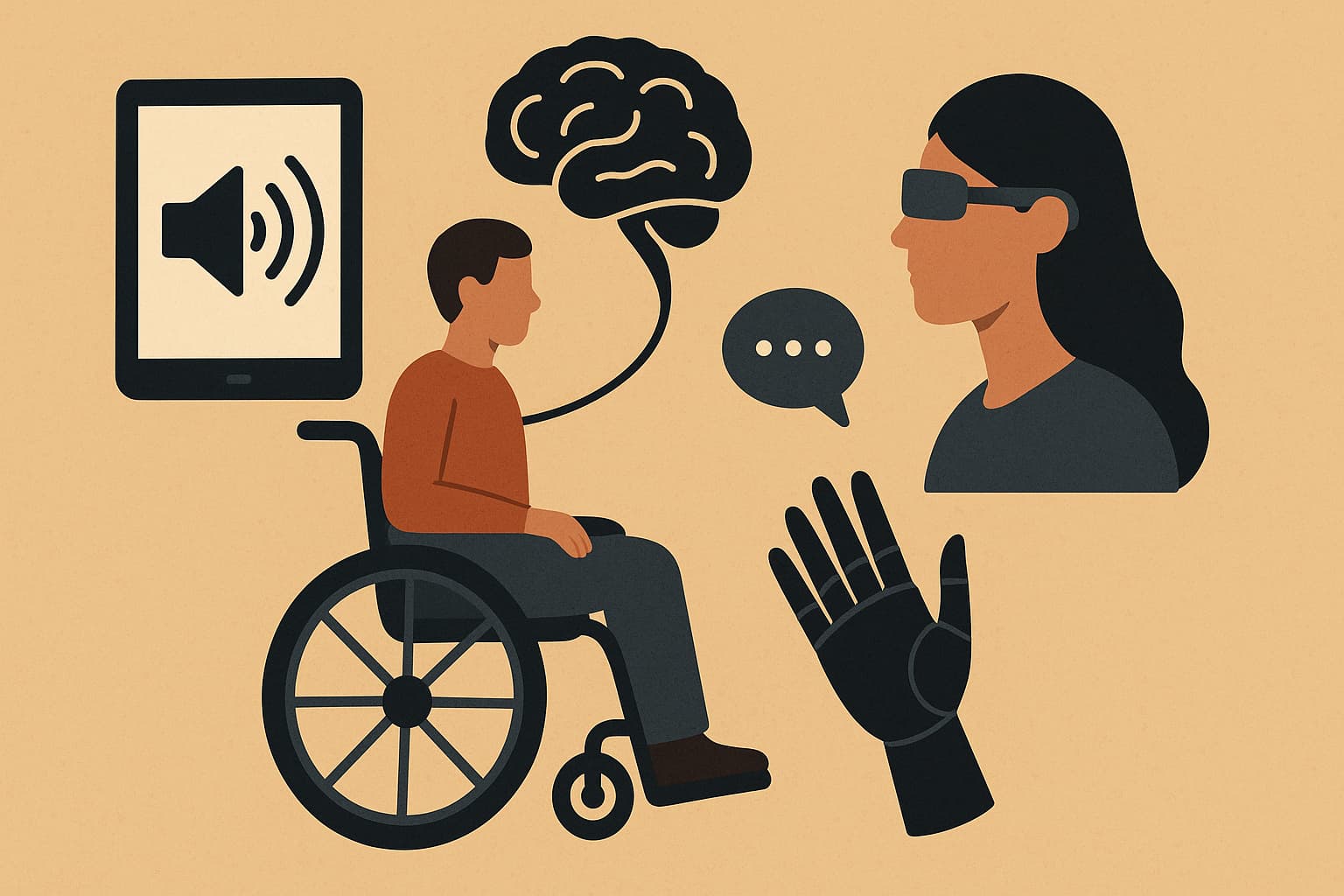
Perhaps nowhere is the transformative power of assistive technology more evident than in communication enhancement. Advanced speech-generating devices now utilize neural networks trained on millions of voice samples to produce natural-sounding speech that reflects the user’s intended emotional tone and personality.
Eye-tracking systems have evolved to detect micro-movements, allowing individuals with severe physical limitations to type at speeds approaching natural conversation. Brain-computer interfaces, once relegated to science fiction, now enable direct thought-to-text communication for individuals with conditions like ALS or severe cerebral palsy.
Real-time translation capabilities integrated into communication devices break down language barriers, while predictive text algorithms understand context and personal communication patterns to suggest complete thoughts with minimal input. These advances transform not just the ability to communicate basic needs, but enable complex professional discussions, creative expression, and intimate personal connections.
The ripple effect extends beyond individual users. Families report transformed dynamics when previously non-verbal members can suddenly express complex thoughts, emotions, and preferences. Educational settings become inclusive environments where students with communication disabilities participate fully in classroom discussions and collaborative projects.
Mobility Redefined: Beyond Traditional Boundaries
The mobility sector showcases some of the most dramatic technological leaps in assistive technology. Smart wheelchairs equipped with collision avoidance systems, GPS navigation, and automatic terrain adjustment transform navigation challenges into seamless journeys. These systems learn preferred routes, remember frequently visited locations, and even predict optimal travel times based on traffic patterns and accessibility considerations.
Exoskeleton technology has progressed from experimental prototypes to practical devices that enable individuals with spinal cord injuries to walk, climb stairs, and perform standing tasks. Advanced models incorporate feedback systems that provide sensory information to the brain, creating a more natural walking experience while strengthening unused muscle groups.
Prosthetic limbs now feature tactile feedback systems that transmit pressure and texture information directly to the nervous system. Mind-controlled prosthetics respond to neural signals with precision that rivals natural limb function, while 3D printing technology makes customized solutions accessible and affordable for users worldwide.
Beyond individual devices, smart city infrastructure increasingly incorporates accessibility features. Intelligent traffic systems extend crossing times automatically when detecting mobility aid users, while indoor navigation systems provide audio-guided routes optimized for wheelchair accessibility or visual impairment considerations.
Sensory Enhancement: Expanding Perceptual Horizons
Visual and auditory assistive technologies have transcended simple amplification to create entirely new ways of perceiving and interacting with the world. Smart glasses for the visually impaired utilize computer vision to provide real-time audio descriptions of surroundings, read text aloud, recognize faces, and even identify currency denominations.
Haptic feedback systems translate visual information into tactile sensations, allowing blind users to “feel” digital interfaces, navigate virtual environments, and even experience visual art through touch. Advanced screen readers now interpret complex graphical content, mathematical equations, and data visualizations with unprecedented accuracy.
For individuals with hearing impairments, real-time captioning systems powered by advanced speech recognition provide instant text translations of conversations, lectures, and media content. Smart hearing aids automatically adjust to environmental conditions, filter background noise, and can connect directly to smartphones, televisions, and public address systems.
Sensory substitution technologies create new pathways for information processing. Devices that convert visual information to audio patterns or tactile vibrations enable users to develop new forms of spatial awareness and environmental understanding that complement or replace traditional sensory channels.
Cognitive Support: Enhancing Mental Capabilities
Assistive technology for cognitive disabilities represents one of the fastest-growing sectors, addressing conditions ranging from autism spectrum disorders to dementia, ADHD, and traumatic brain injuries. Smart scheduling systems provide personalized reminders, break complex tasks into manageable steps, and adapt to individual cognitive patterns and energy levels.
Memory enhancement applications utilize spaced repetition algorithms, visual association techniques, and personalized learning pathways to support information retention and skill development. These systems prove particularly valuable for individuals recovering from brain injuries or managing progressive cognitive conditions.
Social navigation applications help individuals with autism interpret social cues, practice conversation scenarios, and build confidence in social interactions. Virtual reality environments provide safe spaces to practice challenging social or professional situations before encountering them in real life.
Attention and focus enhancement tools utilize biometric monitoring to detect cognitive fatigue, recommend optimal break timing, and adjust environmental factors like lighting and sound to maintain peak mental performance. These systems learn individual patterns and preferences to provide increasingly personalized support over time.
Educational Transformation: Unlocking Academic Potential
Educational assistive technology has evolved from basic accommodations to sophisticated learning enhancement systems that benefit all students while specifically addressing disability-related challenges. AI-powered tutoring systems adapt teaching methods to individual learning styles, processing speeds, and sensory preferences.
Voice recognition software enables students with writing difficulties to produce complex written work through dictation, while advanced grammar and style checking systems provide real-time feedback and suggestions. Text-to-speech systems with natural-sounding voices make written content accessible to students with dyslexia, visual impairments, or processing difficulties.
Virtual reality educational environments create immersive learning experiences that accommodate various sensory and mobility limitations while providing engaging, interactive content. These systems can simulate historical events, scientific phenomena, and complex mathematical concepts in ways that traditional textbooks cannot achieve.
Collaborative learning platforms incorporate accessibility features from the ground up, ensuring that students with disabilities can participate fully in group projects, peer discussions, and online learning communities. Real-time translation and captioning services break down communication barriers in diverse educational settings.
Workplace Integration: Professional Empowerment
The professional landscape has been transformed by assistive technology that enables individuals with disabilities to compete on equal footing in virtually every career field. Advanced screen magnification software with AI-enhanced image processing allows visually impaired professionals to work with complex visual data, technical drawings, and multimedia content.
Voice-controlled computing systems enable hands-free operation of sophisticated software applications, while predictive text and auto-completion features accelerate document creation and coding tasks. Ergonomic adaptations powered by sensors and AI adjust workstation configurations automatically based on user posture, fatigue levels, and task requirements.
Remote work capabilities, accelerated by global workplace changes, have particularly benefited professionals with disabilities by removing commuting barriers and enabling customized work environments. Video conferencing platforms now include real-time captioning, sign language interpretation windows, and accessibility features that ensure full participation in virtual meetings.
Project management and collaboration tools incorporate disability-aware scheduling that accounts for medical appointments, energy management, and accessibility considerations. These systems help create more inclusive work environments while maximizing productivity and job satisfaction.
Healthcare Innovation: Personalized Medical Support
Healthcare applications of assistive technology extend far beyond traditional medical devices to encompass comprehensive health management systems. Wearable sensors monitor vital signs, medication adherence, and activity levels while providing early warning systems for potential health complications.
Telemedicine platforms designed with accessibility in mind enable individuals with mobility limitations to access specialist care remotely, while AI-powered diagnostic tools assist healthcare providers in identifying disability-specific health concerns and treatment adaptations.
Mental health applications provide personalized therapy exercises, mood tracking, and crisis intervention resources specifically designed for individuals with disabilities who may face additional psychological challenges related to accessibility barriers and social stigma.
Medication management systems utilize smart packaging, voice reminders, and smartphone integration to ensure proper medication adherence while tracking side effects and interactions. These systems prove particularly valuable for individuals with cognitive disabilities or complex medication regimens.
The Economic Impact: Driving Innovation and Growth
The assistive technology sector represents a rapidly growing economic force that extends far beyond its immediate users. Innovations developed for accessibility often find mainstream applications, creating the “curb-cut effect” where solutions designed for disabilities benefit the broader population.
Voice recognition technology, originally developed for individuals with mobility limitations, now powers virtual assistants used by millions worldwide. Predictive text algorithms, designed to assist users with motor difficulties, have become standard features in smartphones and computers. Captioning technology, essential for deaf and hard-of-hearing users, now enhances video content consumption for everyone.
Investment in assistive technology research and development creates high-tech jobs, drives innovation in related fields, and generates intellectual property that benefits entire technology ecosystems. The economic participation enabled by assistive technology increases tax revenues, reduces dependence on social services, and creates a more productive workforce.
Future Horizons: Emerging Technologies and Possibilities
The future of assistive technology promises even more dramatic transformations as emerging technologies mature and converge. Brain-computer interfaces are moving toward non-invasive systems that could enable direct mental control of devices and environments. Quantum computing may provide the processing power necessary for real-time language translation, complex environmental analysis, and predictive health monitoring.
Nanotechnology applications could lead to implantable devices that restore sensory function, monitor health conditions at the cellular level, and provide continuous therapeutic interventions. Augmented reality systems may create overlay information systems that enhance navigation, social interaction, and task completion for users with various disabilities.
Artificial intelligence continues to evolve toward more intuitive, context-aware systems that anticipate needs and adapt automatically to changing circumstances. Machine learning algorithms will become more sophisticated at recognizing patterns, predicting challenges, and suggesting optimizations for individual users.
Challenges and Considerations: Navigating the Path Forward
Despite remarkable advances, significant challenges remain in the assistive technology landscape. Cost barriers continue to limit access to cutting-edge solutions, while insurance coverage often lags behind technological capabilities. Digital divide issues mean that the benefits of advanced assistive technology may not reach all populations equally.
Privacy and security concerns become more complex as assistive devices collect increasingly detailed personal information and connect to cloud-based services. Ensuring data protection while maintaining functionality requires careful balance and robust cybersecurity measures.
Standardization and interoperability challenges can create barriers when different devices and systems cannot communicate effectively. Users may find themselves locked into specific technology ecosystems, limiting flexibility and increasing costs.
Training and support requirements increase as technology becomes more sophisticated, requiring ongoing education for users, families, and support professionals. Ensuring that technological advancement doesn’t outpace human adaptation remains an ongoing concern.
Building an Inclusive Future: The Path Forward
The revolution in assistive technology represents more than technological achievement—it embodies a fundamental shift toward recognizing the full potential of all individuals regardless of physical or cognitive differences. As these technologies become more sophisticated, affordable, and widely available, they promise to create a more inclusive society where disability becomes increasingly irrelevant to personal and professional achievement.
Success in this endeavor requires continued collaboration between technology developers, disability advocates, healthcare professionals, and users themselves. Policy frameworks must evolve to support innovation while ensuring equitable access. Educational systems need to prepare professionals who understand both technological capabilities and human needs.
The transformation is already underway, touching millions of lives and reshaping social perceptions about disability and capability. As we look toward the future, assistive technology stands poised to eliminate many of the remaining barriers that limit human potential, creating opportunities for participation, achievement, and contribution that previous generations could never have imagined.
The revolution in assistive technology isn’t just changing how people with disabilities navigate the world—it’s changing the world itself, creating a more accessible, inclusive, and innovative society that benefits everyone. In this transformation, we glimpse not just technological progress, but human progress in its most profound form.